About Irrigation

At KC Agro, we are committed to delivering sustainable and efficient irrigation solutions across our agricultural areas. This overview presents the scope and innovation of our irrigation infrastructure in Hitias, Topolovăţu, and Ianca, highlighting key systems, technologies, and capacities that support productive and resilient farming.

Water Supply & Distribution

The water supply and distribution system in the irrigation area is the backbone of the entire agricultural infrastructure, designed to ensure consistent, efficient, and reliable delivery of water to a wide area of cultivated land. It begins with the primary intake point located on the River, a dependable surface water source that supports the seasonal and long-term irrigation needs of the region.

At the river intake, a set of powerful pumps draws water and transfers it into the system. These pumps are engineered to handle large volumes and are equipped with intake filters—specifically Riverscreen-type filters—to prevent debris, sediment, and aquatic vegetation from entering the system. This filtration step is essential for protecting pumps and pipes from clogging and wear, ensuring the longevity and reliability of the equipment.

The layout of the network has been optimized to minimize friction losses and ensure even distribution, regardless of terrain variations or field layout. The use of modern materials and engineering practices ensures durability, low maintenance, and high flow efficiency.

Overall, the water supply and distribution system is a robust and flexible solution designed to meet the irrigation demands of a modern, high-performing agricultural operation. Its integration of river intake, reservoir storage, dual pumping stations, and a well-structured pipeline network makes it a reliable foundation for sustainable farming in the region.

Irrigation Infrastructure

The irrigation infrastructure has been carefully planned and developed to ensure maximum coverage, efficiency, and adaptability across a diverse agricultural landscape. A key feature of the system is its hybrid design, which integrates both fixed and mobile irrigation technologies to meet the varying needs of different crops and field configurations.

Central to the setup are the center pivot systems, which are installed in both fixed and towable configurations. Fixed pivots are permanently anchored and cover large, circular fields with high precision. The towable pivots add a layer of flexibility, allowing the equipment to be moved between predefined pivot bases as needed. This mobility is particularly valuable in areas where full-time, dedicated pivot systems are not feasible or where rotating crops seasonally requires shifting irrigation equipment.

Each pivot is capable of irrigating a significant radius and is equipped with adjustable sprinklers that can be calibrated according to soil type, crop requirements, and current weather conditions. This customization helps reduce water waste, improve uniformity in distribution, and support better crop performance.

In addition to the pivot systems, the infrastructure includes a series of hose reel irrigators—commonly referred to as irrigation reels. These units are ideal for areas that are irregularly shaped or difficult to reach with pivot arms. They consist of a long hose connected to a mobile sprinkler cart, which can be moved from one part of the field to another. These systems are especially useful for temporary or supplementary irrigation, providing coverage flexibility in tight or variable terrain.

The overall design of the irrigation infrastructure emphasizes scalability and adaptability. It can accommodate a range of crop types and planting patterns, making it suitable for both intensive row cropping and broader field-scale agriculture. With this combination of fixed and mobile technologies, the system maximizes land use, reduces labor, and improves water management efficiency across the entire irrigated area.

Monitoring & Automation

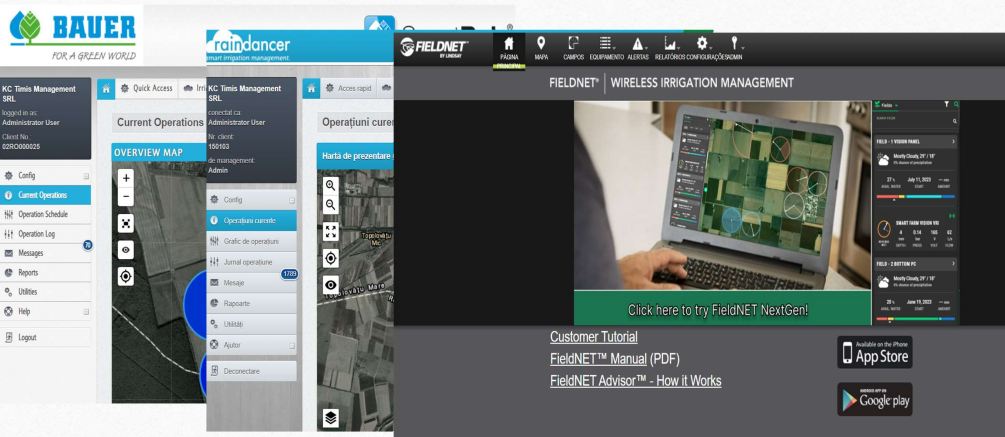
Advanced monitoring tools have been integrated to optimize irrigation management. Soil moisture sensors are distributed throughout the fields, providing real-time data on soil conditions. This enables informed decisions about when and how much to irrigate. An on-site weather station collects detailed climatic data, helping to tailor irrigation schedules to actual field conditions. To protect the system, high-efficiency filtration units are installed at the river intake points, preventing debris from entering and damaging the infrastructure.

Support Structures & Add-ons

To ensure long-term stability, reinforced concrete platforms have been constructed at all pivot installation points. The infrastructure also includes a fertigation system, allowing nutrients to be delivered directly through the irrigation water—improving crop health and reducing fertilizer waste. Additionally, bridges have been built over existing drainage channels, allowing the pivot arms to cross without obstruction, ensuring uninterrupted operation across the entire cultivated area.